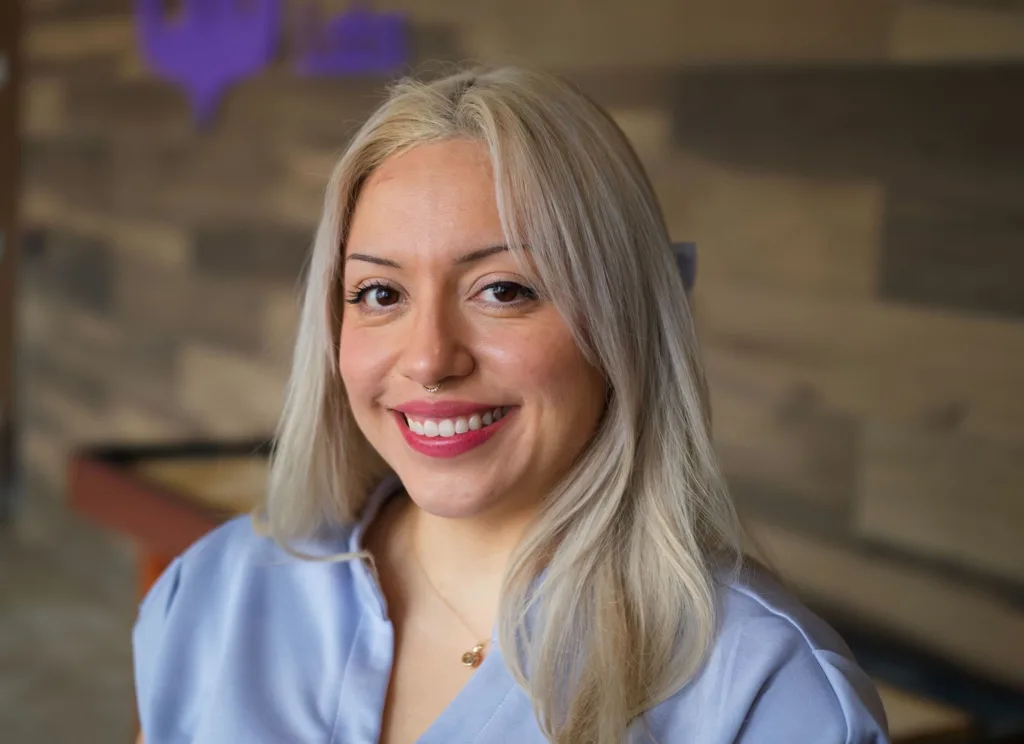
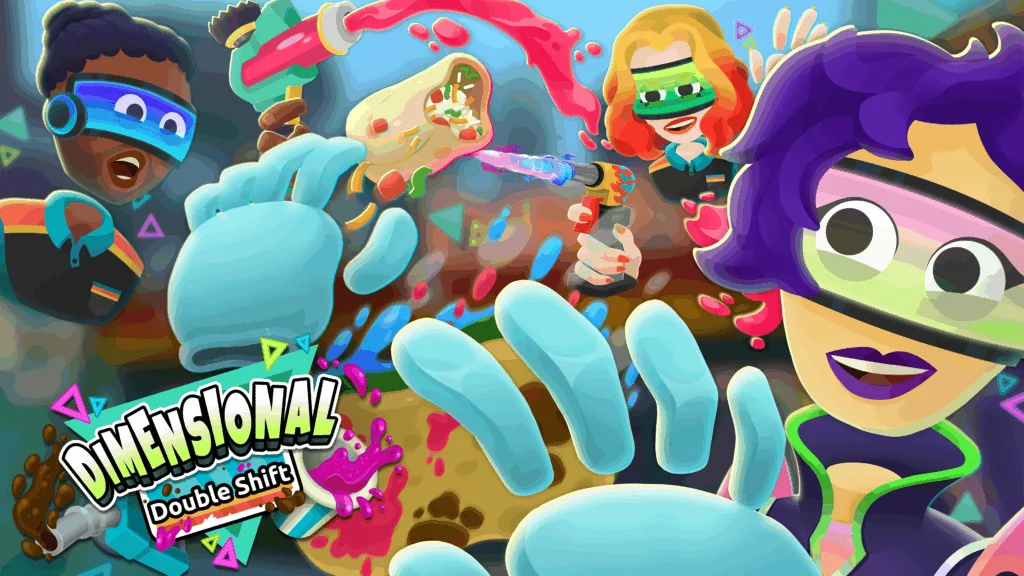
Jazmin Cano is the User Experience Research Lead at Owlchemy Labs, where she champions the mission of making VR for everyone. With a decade of experience in the XR industry, Jazmin leverages her unique perspective as a neurodivergent individual, and the perspectives of participants in her research, to inform the projects she leads and contributes to. Her deep empathy and ability to consider a wide range of perspectives guide the development of accessible solutions. Jazmin’s recent work focuses on social XR game accessibility, with a current focus on the multiplayer title, Dimensional Double Shift, furthering Owlchemy Labs’ commitment to inclusive gameplay.
How did you get your start in user experience (UX) research and extended reality (XR)? What led you to your current role as User Experience Research Lead at Owlchemy Labs, an XR studio that develops playful VR games and experiences? What does your day-to-day role look like?
My start in XR was the start of my career, and it began at a startup creating educational immersive experiences for children staying at SickKids hospital. There’s a bit of overlap between that job and this one I have now in regards to thinking about the player. Knowing there are physical limitations, whether the user is in a hospital chair or xsitting in a wheelchair, we want the experience to be as comfortable as possible.
Not long after the studio closed its local office, I joined a social XR platform that was playable in VR and on desktop. I was building 3D environments and creating experiences across different live worlds on the platform. Because the platform was the engine itself, development and reviews were done on a server that the public could access. We kept our worlds public. A great benefit of building this way was that we got live feedback throughout a project’s development, and if we made something confusing, too small to read, or challenging to use, we heard about it directly from users.
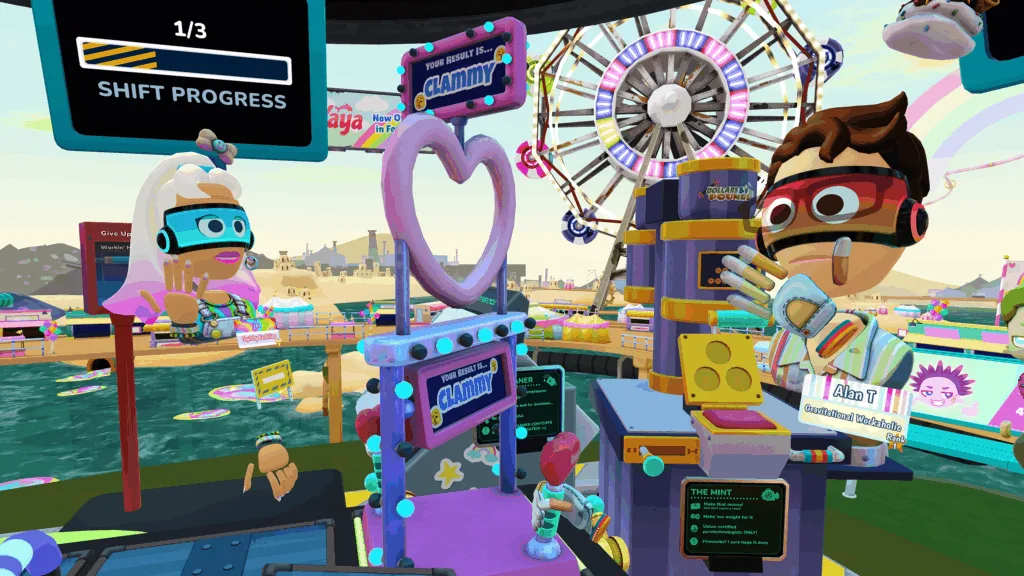
As the user base grew and moderators were hired, my work evolved from creating art assets to managing the in-world moderation team, overseeing virtual events, and writing reports that highlighted challenges and opportunities for improvement. One day, the company’s CEO asked me if I knew what “accessibility” was. I didn’t but when he described it to me, I excitedly realized, “That’s what I’m doing!” The combination of devices (VR headsets, desktop mode, mobile), a live platform, and the ability to chat with people from around the world all lined up to convert me into an accessibility product manager.
From that moment, I knew that working in accessibility was what I wanted to do. That’s why when I got the job at Owlchemy Labs, a leader in XR accessibility, it was some of the most exciting news I had ever received. It has been amazing ever since.
My day-to-day work changes on a daily and weekly basis, which keeps things interesting and engaging since I get to work cross-functionally with different teams and on different initiatives. Overall, my time is spent conducting research related to projects we’re working on and accessibility projects I own. This could be a research project where I’m collaborating with external partners, designing and developing a game feature, or even reviews of marketing plans to highlight opportunities where we can create additional, accessible materials.
Owlchemy Labs is known for making virtual reality (VR) approachable for a wide audience. How does that mission shape your work in UX research?
“XR for everyone” is my guide. This motto shapes my research in ways that extend the efforts that go into preparation and methodologies. By thinking about “everyone,” I think about people who lack access to games and/or XR generally, either because the hardware isn’t accessible to them or because the content they find interesting isn’t designed in a way that would be playable for them. I also think about the cost of such devices, recognizing that not everyone can afford these at home.
I acknowledge that there will be biases in the research because we partner with groups connected to video game communities and with people who already have laptops, phones, and game devices that make signing up as a participant a smooth experience. This isn’t the same for everyone, so we need to remember that we need to make educated guesses when it comes to considering those who don’t have the gear or connections to have previously signed up. I also acknowledge that doing remote user research means we primarily interact with participants who use XR and are already familiar with it, so we typically don’t get to see the reactions of someone new to the medium.
When making plans, I think about what barriers could prevent us from having a conversation with participants in the first place. This means more intentionality in planning.
The research I’ve conducted has been remote over Google Meet and email. Instead of just writing an ad, quick instructions, a screener, a survey, and scheduling a specific block of time on the calendar for a future play test or user interview, I do the following:
- Ads are written in language that minimizes technical jargon. Instructions are clear and as informative as possible.
- Instructions are written as simply as possible, accompanied by videos or images that demonstrate the instructions (for people who are more visual learners), and they are written with alt texts as well in case the document is being read by someone who is blind or has low vision.
- Screeners and emails are explicitly written to say that we want to hear from people who are disabled and, if they are comfortable sharing what about the experience is challenging and what modifications would make it better, that we want to hear from them. We also want participants to know that if they require accommodations from our end, they should let us know so we can best provide them with what they need, such as an ASL interpreter or additional time for frequent breaks.
Another part of this is making sure that forms and software they are required to use are accessible, meaning they are compatible with assistive technology.
The last example I’ll give for now is that someone with accessibility requirements may need additional time compared to a participant who is tech savvy, fast, and can play without breaks. It’s better to schedule longer sessions and give participants additional time for setup, breaks, and to take as much time as they need to read instructions, figure out UI, controls, puzzles, etc., because there may be learning disabilities present or limited mobility as well.
There are many ways XR for everyone shapes UX research, and I hope this gives insights into how the sessions are thought about and how it’s approached differently.
A core focus of your work is making VR “for everyone.” What would you say are the biggest accessibility challenges in today’s social and immersive XR experiences?
Some of the biggest accessibility challenges in social and immersive XR experiences are providing people with a diverse set of options to connect with others, regardless if one is blind, deaf or hearing impaired, or non-speaking.
For a deaf person to join a public virtual space, they’d want to know what others are saying and hearing. While some may be able to speak, not everyone who is deaf can communicate verbally. They need to be able to communicate with others in the virtual environment. There could be a chat log or a way to share emojis. Solutions like these not only benefit people who are deaf, this can also be used by someone who needs to be quiet while playing, maybe because it’s late where they are. They could be an autistic individual who does not use spoken language to communicate, or perhaps there are language differences among people in the space.
For people who are blind, the lack of screen reader capabilities, navigational options, the ability to change visuals to highlight or audibly pinpoint objects or locations frequently prevent them from enjoying an experience and hearing the stories and narratives in immersive XR. With these big challenges come opportunities to get to know people better and create something new and exciting that would allow more people to participate and experience the joy of XR.
An equally big challenge that comes to mind is the ecosystem of XR devices and their peripherals, along with the operating systems (OS) on them. This is the starting point of getting to an XR experience, so if those are not accessible, no matter how much accessibility went into an app’s design, the device could be the blocker that prevents someone from launching it.
Looking ahead, what excites you most about the future of UX research and accessibility in VR?
The XR devices that are coming soon are going to offer portability unlike anything we’ve had before, and this will provide additional opportunities to conduct UX research in different places and with people who couldn’t comfortably wear a VR headset before. The smaller form factor also becomes more appealing to those who have never experienced XR.
People have said they don’t want to wear a giant, blocky device because it would undo their hairstyle or smudge their makeup. They will have a chance to try XR wearing something that looks much more like an accessory we’re accustomed to seeing—a pair of glasses. It’s hard to take a cute selfie with an XR headset, but with a pair of glasses that you and your friends are wearing, snapping a selfie will make this technology feel much more welcoming and easier to share.
Why does that excite me? Because it means there will be a larger group of people who are able to playtest! The more people who are introduced to XR, the more XR users we’ll have. This means more people to playtest with and receive feedback from, including perspectives we haven’t heard before.