
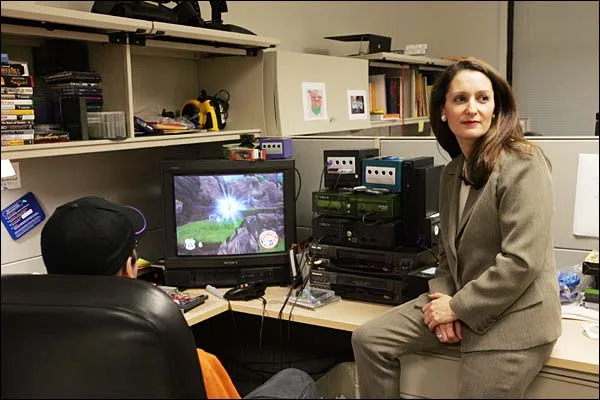
How did you first get involved in the video game industry, and what professional decision points led you to your role as president of the Entertainment Software Rating Board (ESRB)?
Prior to the ESRB, I spent the bulk of my career in media, in particular the early days of cable TV, home video, interactive media, and the internet. In the 1990s, while at Disney/ABC, I was integrally involved in establishing and overseeing two joint ventures: the kids software publisher Creative Wonders with Electronic Arts and the sports games publisher OT Sports with MicroProse, a division of Spectrum Holobyte at that time. In fact, our ABC Sports Monday Night Football PC game was the first of its kind to have online multiplayer competitions!
As Senior Vice President of the ABC Internet Group, I was responsible for a whole host of hugely popular websites such as ABC.com, ABCNews.com, and Oscar.com, and breakthrough projects like the Who Wants To Be a Millionaire online game at the height of the TV show’s popularity and the Drew Carey Show’s April Fool’s Day dueling broadcast/online show. So, interactive media is in my blood. When the ESA reached out to me about heading up the ESRB, some 25 years ago, I was intrigued by the concept of doing something “good” while working in the epicenter of an industry that I love. The public service component of the job —helping parents and families make informed choices —was very compelling to me, as was the role of helping to protect the industry from unnecessary regulation.
When the ESA reached out to me about heading up the ESRB, some 25 years ago, I was intrigued by the concept of doing something “good” while working at the epicenter of an industry that I love. The public service component of the job —helping parents and families make informed choices —was very compelling to me, as was the role of helping to protect the industry from unnecessary regulation.
For readers who may not be familiar, what is ESRB and what does the organization do?
ESRB is the non-profit, self-regulatory body for the video game industry in the United States. Our primary objective is to assign age and content ratings to video games (and now apps) so parents can make more informed decisions about which are appropriate for their family.
ESRB has a bunch of other responsibilities. One important part of ESRB is the Advertising Review Council (ARC), which is responsible for the implementation, administration, and enforcement of advertising guidelines adopted by the video game industry. In this role, ARC staff monitors game packaging, digital storefronts, and game advertising and marketing across all media, including TV, social, online, and print, for compliance with industry adopted marketing guidelines. ARC is also responsible for administering enforcement actions for non-compliance with those guidelines, including sanctions, such as pulling ads or re-manufacturing product to correct rating information, and in some cases imposing fines for acts such as inappropriate target marketing of a Teen or Mature-rated game.
ESRB also runs the ESRB Retail Council (ERC), which consists of the country’s largest video game retailers. Participating retailers voluntarily commit to several measures to prevent the sale of Mature-rated games to children under the age of 17 without a parent present and, more broadly, to help ensure that parents are informed about the ratings. For example, participating retailers display in-store signage explaining the ESRB rating system, train store associates about the ESRB and how to enforce the agreed-upon policies, participate in two mystery shopper audits a year to measure store policy enforcement, and more.
And if that wasn’t enough there’s also ESRB Privacy Certified, a comprehensive privacy certification and compliance program for online products and services published by many of the largest video game, mobile app and toy companies. This 25-year-old program is formally approved by the Federal Trade Commission (FTC) as a Safe Harbor under the Children’s Online Privacy Protection Act (COPPA).
What’s one fun or surprising fact about ESRB that most people might not know?
People are often surprised to learn that Mature-rated games make up around 10% of the ratings we assign in a year. E for Everyone has always been our largest category, representing more than 50% of the ratings assigned in 2025, not including mobile. That is reassuring to many parents who often feel pressured by their kids to buy the latest and greatest Mature-rated game. No need! There’s plenty of other family friendly fare from which to choose.

How does ESRB ensure games are safe and appropriate for younger players?
This may be splitting hairs… but ESRB doesn’t do that! Part of why ESRB exists is to make sure developers have the creative freedom to design the game they want to. So, to reframe: our job is to make sure that consumers — but especially parents — are informed about the content of a game, the context in which it appears to the player, and the interactive features like in-game purchases and user interaction, so they can decide if it’s appropriate for their kids.
To do this, ESRB has a comprehensive rating process. This requires that developers submit video and written materials detailing all the pertinent content that appears in their game. “Pertinent content” means that we need to see the most extreme situations, along with what led to the situation, and what occurs just after. Context is vitally important in the process… why something is occurring is oftentimes just as important as the act itself. We are firm believers that parents know their children best, and ESRB is here to provide reliable, trustworthy information to help them decide if their children are ready for a game or to take preventative measures, such as setting parental controls to limit spending money or manage online communications. In addition to assigning ratings, ESRB provides a ton of other resources to inform and educate parents at esrb.org, ParentalTools.org, VamosAJugar.com, and our mobile app. And we regularly run ratings education and outreach campaigns to directly speak to parents.
Most players and parents are familiar with the age ratings, but can you explain the content descriptors and interactive elements?
You’re correct that Rating Categories are the star of the show, but according to our research, almost just as many parents are aware of (and regularly use) Content Descriptors and Interactive Elements! And they consider all three parts of the system to be important.
ESRB ratings initially launched with two parts: Rating Categories and Content Descriptors. Rating Categories suggest the age-appropriateness of a game or app. If parents want or need more information, Content Descriptors provide details on the content that may have led to the Rating Category assignment.
In 2018, ESRB rolled out Interactive Elements for physical games, which had been part of the ratings assigned to digital-only and mobile games for some time beforehand. The goal for Interactive Elements is to highlight certain features of games and apps that aren’t related to the content of the product, per se, but parents may want to know about. For example, if a game offers the ability to communicate with others online using voice or text chat or sharing user-generated content, ESRB will assign the “Users Interact” notice. Meanwhile, if a game includes the ability to make digital purchases using real world money, ESRB will assign either “In-Game Purchases” or “In-Game Purchases (Includes Random Items),” These signal to parents that they may want to make sure their household rules cover these aspects of a game or to activate parental controls to help manage their kids’ access to those features.
How has ESRB adapted its practices to keep pace with digital storefronts, live-service titles, and mobile platforms?
ESRB has a pretty good track record of ensuring our policies and practices keep up with this ever-evolving and very dynamic industry.
For digital storefronts and mobile platforms IARC is the key. It was a massive, international undertaking that launched in 2013 and has enabled ESRB and other participating rating authorities from around the world to scale the rating process in order to address the huge increase in volume of product, especially on mobile. Our goal was to help ensure that ESRB ratings were available for games regardless of the device or platform on which you play. And IARC is the best way to accomplish that.Live service games are rated like every other game at first. All physical or boxed games with ESRB ratings are tested after release, but for live-service games we will regularly retest them to make sure all of the rating information is still accurate. Should a live service game include an update that changes the pertinent content of the overall product, the publisher must resubmit the game for a new rating assignment.

ESRB ratings are used in the United States and Canada, but other countries have their own rating systems. Tell us about the International Age Rating Coalition (IARC) and how the organization helps parents all over the world when it comes to picking appropriate video games for their kids?
As mentioned, the International Age Rating Coalition (IARC) is a prime example of ESRB’s evolution to keep up with the industry. What I didn’t say is that it’s a revolutionary way to rate content. In the wake of the launch of the iPhone and Android in 2007 and 2008, respectively, along with the apparent shift from physical to digital distribution of video games, it was clear to me that we needed to create a scalable and globally streamlined solution for ratings that also didn’t create high barriers to entry for small developers. The traditional ESRB rating process, nor anyone else’s, simply was not designed to scale to rate hundreds of thousands of products a year. The threat was existential.
In 2011, ESRB began dipping its toe in the water by partnering with the CTIA, the mobile carrier trade association, to rate mobile apps on feature phones and with consoles to rate downloadable games using a different process. This new process was based on a multiple-choice questionnaire that developers completed. The answers were used to calculate an ESRB rating using a complex matrix of logic and, after the product’s release, our raters tested for accuracy of the ratings assigned. When necessary, ratings modifications were handled directly with the platforms.
Once we were comfortable with the viability of this new process, we reached out to other rating authorities around the world, many of whom are government agencies and facing a similar threat of marginalization if not extinction. If we could all agree on a common set of questions that a developer only has to complete once, we could program unique algorithms in each region to assign a rating that reflects each of their own cultural standards and, in some cases, regulations.
After a lot of work, IARC was successfully launched in 2013 and we’ve not looked back. To date, eleven storefronts have licensed and integrated the system with nine participating rating authorities (as well as a legally-compliant rating for Russia and a generic rating for other regions). IARC has issued 20+ million rating certificates to over 3 million developers to date. And IARC storefronts have picked up the tab for developers. Thanks to IARC, billions of parents all over the world have access to rating information they know and trust on many of the biggest and most popular digital platforms.
A rating system only works if people trust and use the ratings. What evidence can you share that the ESRB ratings are effective?
We conduct a survey among parents every year, and a big part of this is to make sure we’re providing information that parents want and need to help keep their kids’ video game experiences appropriate. In fact, ESRB has enjoyed high awareness and use among parents for decades. In 2025, 83% of parents said they were aware of ESRB ratings, and 77% said that they regularly checked them.
Another key component of the survey is to see if there are any aspects of managing video games that the ratings may not cover. Feedback from parents inspired us to add Interactive Element notices to the ratings for features like in-game purchases and in-game communications. For the past few years, parents have cited screen time as their biggest challenge when it comes to managing video games. The ratings obviously don’t cover this, so we developed a suite of resources to help parents manage their kids’ screen time. This includes blogs, a full section in our Family Gaming Guide, and clear instructions to help parents set screen time parental controls on their kids’ devices.
Beyond ratings, what else does ESRB do to help protect children?
ESRB offers a ton of resources to parents to help them manage their kids’ video game experiences. It may be easier for me to list them:
- Rating Search – Parents and consumers can search for ratings on ESRB.org or the ESRB app (for Android or iOS). This does not include games rated by IARC, but those ratings are displayed on product detail pages prior to purchase or download. Many search results also include a rating summary that provides examples of specific content in the game and the context in which that content is experienced.
- Ratings Guide – An in-depth rundown of ESRB’s three-part rating system.
- ESRB Blog – Long form blogs about games that may be of interest to parents like Roblox and Minecraft, tips on how to manage appropriate video game play, platforms often associated with video games like Twitch and Discord, and more.
- Family Gaming Guide – A user-friendly guide offering tips and resources to help parents create safe and appropriate video game experiences for their kids. This includes tips on setting household rules, picking appropriate games, managing screen time, privacy tips, and more.
- Parental Controls Guides – ESRB offers step-by-step parental controls guides for many of the most popular consoles and devices. We also have links to help parents set parental controls for games like Roblox and Fortnite. These guides can help parents manage what their kids play, when and for how long, with whom, and whether they can spend money on new games or in-game purchases. These are all available at ParentalTools.org.
- Advertising Review Council (ARC) – Ensures that parents and consumers are informed of rating information prior to purchase and that game publishers responsibly market their product.
- ESRB Retail Council (ERC) – As mentioned, participating retailers voluntarily commit to several measures to help limit the sale of Mature-rated games to children under the age of 17 without a parent present and, more broadly, to help ensure that parents are informed about the ratings.
ESRB Privacy Certified (EPC) – Also previously noted, a comprehensive privacy certification and compliance program tailored to video game and toy-related online products and services.
Looking ahead, what initiatives are most important for ESRB in keeping the video game community safe, informed, and empowered?
The most important thing ESRB can do is to ensure that its ratings are consistently available for all games, regardless of the platform or device on which you’re playing them. The life of a modern parent is crazy busy, and we want to make it easy for them to be informed about the games their children play and not feel so overwhelmed, particularly when it comes to screens and technology. The industry provides so many great tools beyond ratings, like parental controls and in-game features to block, mute, or report disruptive players. Parents deserve some peace of mind. And, oh by the way, parents should get in there and play with their children whenever time permits. They’ll discover how fun games really are.